How Industrial 3D Scanning Supports Reverse Engineering


3D scanning has become an important tool in reverse engineering. This process helps turn real-world objects into digital assets that can be edited. Reverse engineering itself helps with cost reduction, time-saving, and overall quality of products. The following are just a few ways that 3D scanning benefits reverse engineering:
Improved Efficiency and Speed
Thanks to 3D scanning, the intricate details and shapes of objects can be captured more reliably than when done with tools such as calipers, which can be inaccurate and inconsistent. This accurate data collection reduces overall time taken for reverse engineering projects. 3D scanners can capture millions of data points in mere seconds.
This means less manual work needs to be done. This includes disassembling and measuring parts again and again to check for accuracy. Instead of spending countless hours translating 2D measurements into 3D models, instant digital point clouds are created ready to be imported into CAD software.
When creating reproductions or modifications, 3D scanning creates a digital twin that can be used immediately for printing. Analyzing and tweaking are also easier tasks thanks to reverse engineering.
Improved Quality Control
Reverse engineering allows products to be dismantled and analyzed. As mentioned, this can be time-consuming and inaccurate, especially if the product contains intricate parts. 3D scanning also supports reverse engineering by allowing parts to be analyzed, tested, and reproduced without damaging them.
This non-invasive scanning is the perfect way to reproduce products and parts that are no longer manufactured, or the instructions have been lost. 3D scanning makes it easier to identify problems that are not visible to the human eye, providing the most accurate measurements so that each product or part comes out the same, and prevent recalls that can be costly.
Design Optimization
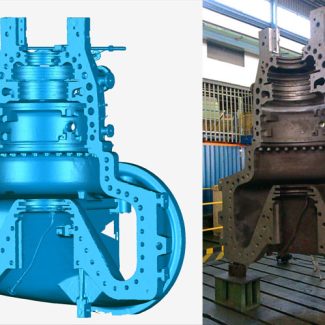
Industrial 3D scanning supports reverse engineering by creating accurate digital replicas that can be used for analysis. For industrial parts and products, design optimization is key. 3D scanning allows complex geometries and internal structures to be studied without taking the product apart. This is especially useful if there is no prototype available to reproduce the product from.
Reverse engineering enables one to more easily see where improvements and modifications may be beneficial. In addition, experimenting becomes possible. Experimenting with thickness, materials, and even shapes is possible with 3D scanning and reverse engineering. Cost reduction can occur thanks to the ability to design parts digitally. Materials will not be wasted in testing. It’s also possible to figure out the lightest, strongest, and most cost-efficient parts.
Industrial 3D scanning supports reverse engineering by enhancing accuracy, flexibility, efficiency, and
cost-savings. Being able to quickly capture the most precise digital representations of complex products and parts, eliminates the time-consuming need to manually measure and analyze them. The capabilities of industrial 3D scanning in reverse engineering are helping to modernize manufacturing workflows.